Our Interests and what we do.
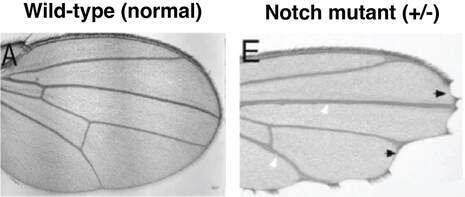 The Notch signaling pathway gets it name from the phenotype associated with mutation of the Notch gene in fruit flies, where it creates a "notch" in the wing
Current research interests in the Albig lab revolve around an ancient cell-to-cell communication mechanism called Notch. Notch is essential for normal development of all animals. For such an important cell communication mechanism, Notch is deceptively simple. It’s sort of like a handshake between two cells. One cell extends it hand (actually called a Notch ligand) and grasps another cells hand (actually called a Notch receptor). This handshake interaction between ligand and receptor sends a signal into the receptor cell. The signal causes a piece of Notch receptors to be cut away on the inside of the cells. This little Notch fragment (actually called a Notch intercellular domain or NICD) travels from the cell membrane to the nucleus where it initiates the transcription of specific genes. This simple handshake mechanism is a critical way that cell communicate. In multicellular animals like us, literally trillions of cells need to communicate with each other, and Notch is one way they do this. When the Notch mechanism goes awry, bad things like deformation, abnormal development, and disease results.
The “textbook” or canonical understanding of Notch may sound relatively simple, but we are learning that it is actually more complex than originally thought and this is where our research starts. We are interested in learning about the “non-canonical” aspects of Notch signaling which includes anything that is not part of the basic handshake mechanism described above. We have explored many aspects of non-canonical Notch signaling such as how extracellular matrix signals change Notch function, how different Notch proteins can cooperate to diversify the Notch signal, and currently we are studying how Notch proteins aggregate into non-membrane bound organelles that we are calling “Notchosomes”. Altogether, our research strives to push the frontiers of what we know about how Notch works forward. As we understand more and more about Notch we will be able to better understand how Notch enabled.
The “textbook” or canonical understanding of Notch may sound relatively simple, but we are learning that it is actually more complex than originally thought and this is where our research starts. We are interested in learning about the “non-canonical” aspects of Notch signaling which includes anything that is not part of the basic handshake mechanism described above. We have explored many aspects of non-canonical Notch signaling such as how extracellular matrix signals change Notch function, how different Notch proteins can cooperate to diversify the Notch signal, and currently we are studying how Notch proteins aggregate into non-membrane bound organelles that we are calling “Notchosomes”. Altogether, our research strives to push the frontiers of what we know about how Notch works forward. As we understand more and more about Notch we will be able to better understand how Notch enabled.
